
Writer:Yukinobu N.
Editor:Syoh C.
Translator:Dinith F

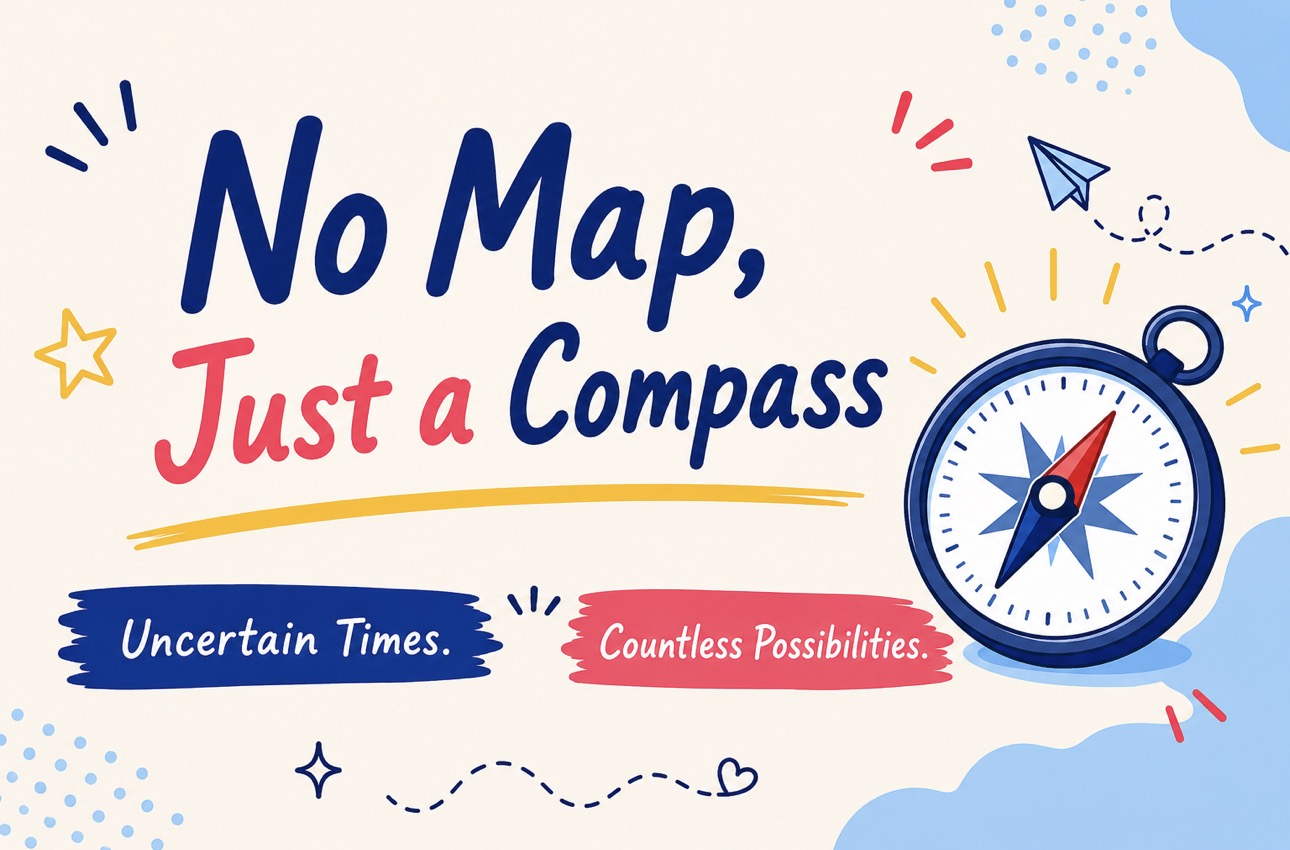
Have you ever thought about your own future? The future consists of both certainty and uncertainty. “Certainty” refers to a state in which the outcomes or prospects of things are clear and easy to predict. On the other hand, “uncertainty” refers to a state in which the future or outcomes are difficult to predict and contain elements that make it unclear what will happen. Everyone is navigating the vast ocean in search of their own “right answer.” In fact, uncertainty lurks right in our daily lives—in our student life, career choices, and relationships. These elements are often intertwined with the anxieties students carry without even realizing it. There is concern that they may significantly impact their daily well-being. In this article, I hope to offer some tips to help you navigate the rough waters—both big and small—in your own unique way.
Uncertainty in Our Daily Lives
Life has several turning points. At those moments, however, we cannot know with absolute certainty which choice will lead to our future. This is because “irreversibility* (the property whereby events or choices that have already occurred cannot be completely restored to their original state)” exists in every aspect of life. We must constantly make choices based on limited information and move forward while facing the consequences of those choices. I believe that irreversibility is not something to be feared or avoided, but rather something to be confronted through experience.
Of course, there are areas that we can control ourselves. However, there are few opportunities in compulsory education to systematically learn what to control, how to control it, and how to face an uncertain future. That is precisely why I believe we learn how to live through the experience of stepping into unfamiliar environments, encountering diverse values, and taking action while occasionally reexamining our own thoughts. For example, new encounters in student life, failures in academics, choices during job hunting, and differences with others in interpersonal relationships all manifest as forms of uncertainty.
Every single choice we make in life becomes a crucial element in shaping our future selves. Therefore, we need to be mindful of what to choose and what to let go of. In other words, we need to make deliberate choices about what to keep and what to let go of. However, rather than coming to a standstill when the answer is unclear, isn’t the courage to take a step forward (to take on a challenge) in order to bring about change also a necessary strength for facing uncertainty?
Uncertainty Is “Possibility”
Every day, we face unexpected events and situations that don’t go as planned. There are times when our efforts don’t lead to results, and times when we’re thrown off balance by unforeseen changes in our circumstances. However, uncertainty isn’t merely a source of anxiety; it can also serve as a catalyst for new possibilities. In his Rational Emotive Behavior Therapy (REBT), psychologist Albert Ellis posited that “it is not the event itself that determines a person’s emotions, but rather how one perceives and interprets that event that influences emotions and behavior.” In other words, even when experiencing the same event, our subsequent actions change depending on the meaning we ascribe to it. Whether you view failure or unexpected outcomes as “the end” or as “an opportunity for personal growth” can drastically change how you approach the future. In student life as well, experiences such as meeting new people, changes in our environment, and encountering different values provide opportunities to reflect on ourselves. When faced with uncertainty, rather than simply accepting it passively, it is important to understand your own tendencies in choosing how to act and use that insight to guide your next steps.
Within uncertainty lie opportunities and possibilities that have yet to take shape. New encounters can broaden your values, and unknown experiences can help you realize your own potential. Isn’t uncertainty, precisely because the future is not yet determined, a space that can be shaped by your own actions?
From “Searching for the Right Answer” to “Making the Chosen Path the Right One”
When making life choices, we tend to instinctively search for the “right answer.” It is natural to seek choices that we won’t regret or that won’t lead to failure. However, in a future filled with uncertainty, it is not easy to find the perfect choice from the very beginning. Albert Ellis interpreted this concept in Rational Emotive Behavior Therapy (REBT) as follows:
“People are not troubled by events, but by their interpretation of those events.”
This perspective shows that even when facing the same experience, the way we face the future changes depending on the meaning we ascribe to it. In other words, rather than evaluating our judgment based solely on the outcome of a choice, what matters is how we perceive that experience and use it to guide our next actions.
Furthermore, psychologist and psychiatrist Viktor Frankl wrote the following in his book Man’s Search for Meaning:
“Everything can be taken from a man but one thing: his last freedom—the freedom to choose his attitude toward a given situation.”
This reflects the idea that even though we cannot control our environment or outcomes entirely as we wish, how we interpret those experiences and what actions we choose to take are entirely up to us.
In life, the “right answer” for a path is not determined the moment a choice is made. Rather, it is through the efforts and actions we take after making a choice—and the experiences we gain from them—that we give meaning to that path. Precisely because the future is uncertain, what we need is not to keep searching for the perfect answer, but rather an attitude that allows us to make the path we’ve chosen into the right one.
In Closing
Our lives are always filled with unpredictable events and moments of choice. Uncertainty is not merely a source of anxiety or fear; it is also an opportunity to encounter new values and possibilities. However, pursuing every possibility is not necessarily the right answer. Choosing one thing within a limited amount of time means, at the same time, letting go of something else. Giving up is by no means a negative act; it is a choice we make to identify what is truly important to us and to move forward into the future.
Frankl stated that no matter what situation a person finds themselves in, they have the freedom to choose their attitude toward that situation. As these words suggest, we cannot control everything that will happen in the future. However, how we perceive those experiences and what meaning we ascribe to them is entirely up to us.
When we look back at the end of our lives, what truly matters is not “how perfect our choices were,” but rather “how much meaning we were able to find in the path we chose and how fully we were able to face it.”
Precisely because the future is uncertain, we must maintain a positive mindset and not give up on our potential too easily. At the same time, we must have the courage to choose what is truly necessary for ourselves. I believe that is the strength that allows us to build a life true to ourselves amid uncertainty.



コメントを残す