
Writer: Ezekiel K.
Editor: Audrey S.
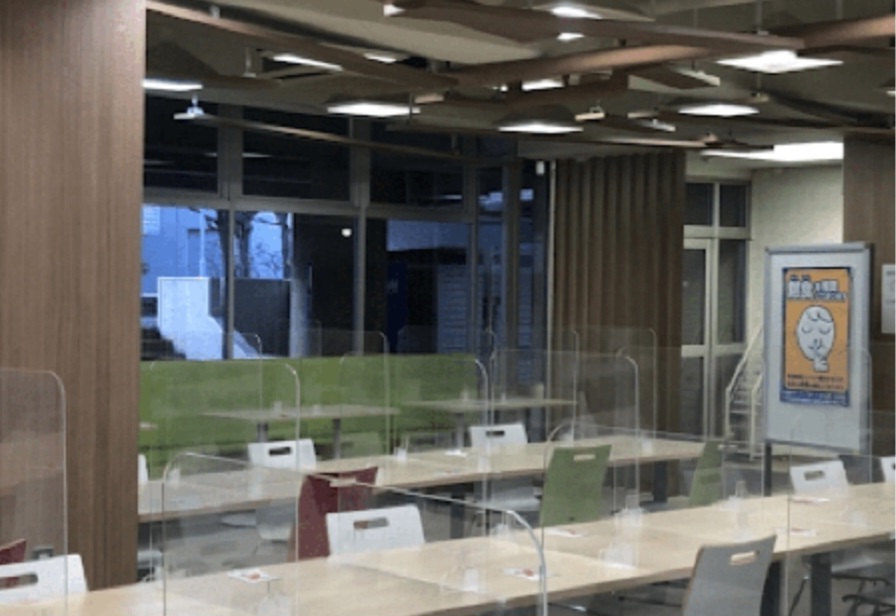
Can you guess how many cafeterias there are on the TIU campus? Believe it or not, Campus 1 of TIU has two cafeterias! Yes, there are two cafeterias where E-track and J-track students can order a range of lunch options. Besides the two cafeterias, there are also two food trucks and a convenience store on Campus 1. The main cafeteria primarily serves Japanese cuisine, including ramen, tonkatsu, Japanese curry and rice, tempura over rice, and more. The second cafeteria offers a variety of curries and naan! One food truck offers Turkish Kebabs, while the other offers Japanese cuisine (such as fish over rice.) Finally, the convenience store has all the onigiri (Japanese rice balls) and instant ramen a person could ever want!
Whether you want to satisfy your hunger and engage in conversation during your lunch break or your leisure time, TIU cafeterias have you covered. Cafeterias on the TIU campus are all large enough to accommodate a significant number of students and provide a diverse menu to meet the needs of the TIU community. Important to note, the TIU cafeteria offers a specific menu for students with dietary restrictions due to religion or other factors.
This map shows the layout of “the” TIU campus. from it you can see that the two cafeterias are located at building number 12 and 16 respectively.

Reference: https://www.tiu.ac.jp/campus/campus01/
In this article, we shall exclusively look at TIU Cafeteria 3 in building number 12. Cafeteria 3 has a weekly menu that is specially designed for students to experience the taste of Japanese cuisine. Every menu has clearly stated calorie content for those on a diet or following a strict calorie plan. This article focuses on five menu items.
1.Katsu Curry
Katsu curry is a traditional Japanese dish consisting of a pork cutlet served alongside a serving of Japanese rice and curry. It is customary to eat the dish with a spoon or a fork, and it is presented on a sizable plate. It is not necessary to use a knife because the cutlet is typically already cut into strips.

Calorie content: energy-936 kcal, protein-27.7g, fat-28.1g, carbs-148.7g, salt-5.6g.
2.Gomoku chūkadon
Chukadon is a meal that is commonly found in Japanese fast-food restaurants. The dish is served in a bowl and consists of rice topped with stir-fried veggies, onions, and mushrooms as well as thin slices of beef. Its name, which translates to “Chinese rice bowl,” reflects its origins in Chinese cuisine. It resembles a donburi in certain ways.

Calorie content: energy-625 kcal, protein-20.4g, fat-11.4g, carbs-112.7g, salt-3.9g.
3.Kaki fry oysters
Kaki fry is a popular Japanese meal consisting of breaded oysters that have been deep-fried. Although it is frequently found on the menus of restaurants, kaki fry is also commonly prepared in households. After being seasoned only with salt and pepper, the oysters are then breaded using a technique for Japanese cuisine that involves flour, an egg, and crisp panko breadcrumbs. Being coated in breading, the oysters are subsequently cooked in hot oil until they are golden brown and crunchy. Traditionally, kaki fry is served with fresh lemon wedges and either tonkatsu sauce or tartar sauce on the side.

Calorie content: energy-453 kcal, protein-9.6g, fat-34.2g, carbs-26.7g, salt-1.9g.
4.Taiyou no tomato men
The Tomato Cheese Ramen is a bowl of ramen that is made using tomato soup as the basis and is topped with a mountain of cheese powder and some chopped basil. It comes with a small portion of rice that can be used to finish any soup that is left over. The primary tomato soup is made by combining a high concentration of tomato sauce with a chicken soup that is low in fat.

Calorie content: energy-725 kcal, protein-24.4g, fat-32.5g, carbs-84.4g, salt-7.8g.
5.Gyokai tonkotsushōyu tsukemen
A robustly textured, thick noodle is paired with a soup that gets its high thickness from a rich pork bone stock and is infused with umami from Katsuobushi (dried bonito flakes) and Niboshi. The dish’s name, Gyokai Tonkotsu Tsukemen, translates to “Seafood pork bone soy sauce dipping noodles.” Tonkotsu is Japanese for “pig bones,” and the word “Gyokai” refers to any ingredient from a body of water, including lakes, rivers, and the ocean. In the context of ramen, the terms dried bonito, mackerel, and sardines are referred to collectively under the name “Gyokai.”

Calorie content: energy-886 kcal, protein-32.2g, fat-29.5g, carbs-133.7g, salt-7.6g.
Needless to say, Cafeteria 3 offers a variety of other mouthwatering menu options that are not discussed in this article. However, with these five specially selected menu items, we hope that we whet your appetite enough to visit Cafeteria 3 so that you can experience the great flavors of Japan while you are on campus.




 Times Of TIU
Leave a comment