

Author: Hinata S.
Editor: Yuki N.
Translator: Jonathan S.
Momotaro is known as one of Japan’s most famous folktales. It tells the story of a boy born from a giant peach that floated down a river, who later travels to Onigashima (Demon Island) to defeat the demons. This story is not merely an adventure—it teaches important values for living in society, such as cooperation, courage, and respect for diversity. Even for modern university students, there is much to learn from Momotaro’s tale.
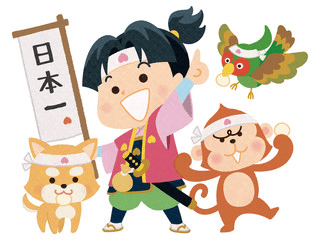
Momotaro and the Three Animals
The story begins with an elderly couple who decide to lovingly raise a child born from a peach—Momotaro. As he grows up, Momotaro learns that demons have been tormenting people, and he resolves to set out for Onigashima to defeat them. This courage to stand up for justice is one of his greatest traits. On his journey, Momotaro meets three animals: a dog, a monkey, and a pheasant. Although they initially clash, Momotaro’s kindness and leadership bring them together as a team. The dog bites the demons, the monkey scratches their backs, and the pheasant pecks at their eyes. By combining their unique abilities and strengths, they succeed in defeating the demons on Onigashima.

The Importance of Cooperation
One of the main lessons from this story is the importance of working together.
Momotaro could only achieve his goal with the help of his companions. Similarly, in today’s society—whether in group projects or team-based work—success comes from making use of each member’s individuality and cooperating toward a shared goal. Like Momotaro, effective leadership is also essential. By trusting others and showing good character, one can earn the loyalty and support of their teammates.

Respect for Diversity
Another key lesson relevant today is respect for diversity. Each of Momotaro’s animal companions had distinct personalities and abilities. By recognizing and utilizing their individual strengths, they were able to defeat the demons. This idea is highly significant in modern society: respecting the unique traits of others and harnessing everyone’s strengths enables us to overcome difficult challenges together.

The Courage to Take on Challenges
We must also not forget Momotaro’s courage. He faced danger without fear and stayed true to his convictions. This spirit of taking on the unknown also applies to university students today. When faced with new environments or challenges, having the courage to act without fear leads to personal growth.

Conclusion
Although Momotaro is an old folktale, it still offers valuable lessons for university students today. Cooperation, courage, and respect for diversity are essential elements for living in modern society. Like Momotaro, we must learn to work with others and face challenges head-on—these are the strengths that will be required in the world ahead. Even now, Momotaro remains a symbol of cooperation and courage for the Japanese people, and for us university students, his story continues to serve as a guide for life.




 Times Of TIU
Leave a comment