

Writer: Munkhjargal D.
Editor: Zyla H.
Translator: Yohei S.
Kappa are water-associated yokai from Japanese folklore. These are supernatural creatures that range from spirits and shape-shifters to demons and mysterious beings. The name “kappa” comes from kawa (river) and wappa (child), meaning “river child.”
They appear as small, child-sized humanoids with turtle-like faces, scaly skin, a shell on their back, and a beak-shaped mouth. A distinctive water-filled hollow (sara) on the top of their head is said to hold their power and life force. Kappa are adapted for swift swimming and feature webbed membranes between their fingers and toes, and in some depictions, arms connected across the torso to aid lateral movement. Like many yokai, kappa can be benevolent, mischievous, or dangerous depending on the story.

An image of a Kappa emerging from a river to scare away a child.
The origins of the Kappa in recorded history date back to the Edo period (1603–1868). During this time, many folktales and supernatural stories were compiled in written form, preserving older oral traditions. Kappa legends appear in texts such as “Kasshi Yawa” and various regional folklore records.
The stories vary widely between different areas of Japan. In some regions, Kappa are seen as playful tricksters who love sumo wrestling and enjoy pulling pranks on unsuspecting people. In others, they are feared as malicious water demons responsible for drownings.

An old Edo-era drawing of Kappa.
These freshwater yokai are mischievous and potentially dangerous. Associated with rivers, ponds, and canals, kappa are small but unusually strong; many tales tell of them dragging people or animals beneath the water and, according to some legends, extracting a mysterious, life-linked sphere called the shirikodama, sometimes linked in folklore to the anus or prostate. To protect themselves, villagers traditionally offer cucumbers (often with a child’s name carved into one) or set off fireworks to ward off these spirits.
Kappa are also bound by a peculiar politeness: they carry a hollow on their head filled with water that sustains their power. If it is spilled or dries up, they become docile, so a respectful bow can force a kappa to bow back and lose its strength, allowing escape or negotiation. Clever humans in stories sometimes trade respect or offerings for the kappa’s knowledge of medicine, agriculture, or martial arts; kappa enjoy sumo and shogi and are said to favor cucumbers.
As cultural symbols, kappa serve a dual role as cautionary figures used to keep children away from dangerous water and ambiguous supernatural beings capable of both harm and helpfulness depending on how they are treated.

A Kappa eating a cucumber.
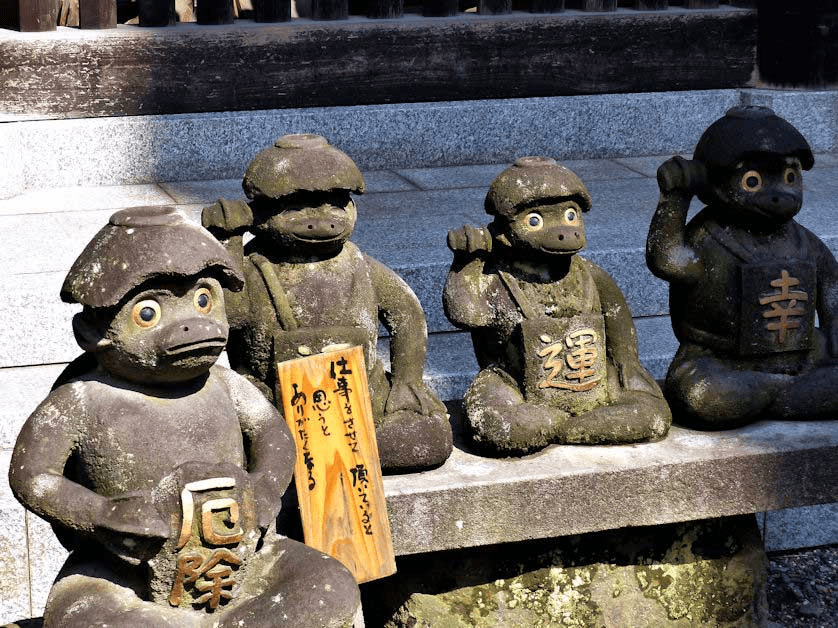
Over centuries, Kappa have grown beyond folklore into cultural icons. They appear as stone statues near rivers, shrines, and temples. In some towns, Kappa festivals celebrate local legends, blending tradition with modern festivities. The creature’s image can be seen on warning signs near rivers, continuing its role as a protector through fear and caution.
In modern media, Kappa have undergone a transformation. Manga, anime, and video games often depict them as small, frog-like beings with cheerful expressions. This shift from a terrifying yokai to a friendly mascot reflects broader cultural changes in Japan, where many traditional spirits and demons have been adapted into pop culture. Characters like Kappa appear in well-known franchises, becoming recognizable symbols even outside Japan.

A Kappa character in the popular game franchise, Yo-Kai Watch.
The Kappa has remained an enduring figure in Japanese folklore for centuries. It began as a feared water spirit, warning communities of danger, and has evolved into a cultural mascot recognized worldwide. Its dual nature both playful and dangerous, reflects how folklore adapts over time while preserving its core messages. The Kappa stands as a reminder of the respect owed to nature and the power of stories to shape cultural identity.




 Times Of TIU
Leave a comment